

Beyond Boundaries: Telerehabilitation and the Virtual Care Revolution
A 3 Day Virtual National Conference
April 20, May 4 & May 8, 2026
9:00 a.m to 1:00 p.m. (CST)
A fully bilingual event
Join rehabilitation professionals, researchers, clinicians, technologists, and patient partners from across Canada for Beyond Boundaries: Telerehabilitation and the Virtual Care Revolution, a three‑day virtual conference exploring the rapidly evolving world of telerehabilitation. This conference brings together leading professionals, researchers, and clinicians from around the nation who are helping to shape the future of Virtual care.
This fully bilingual conference has been planned in collaboration with the University of Saskatchewan School of Rehabilitation Science, University of Alberta Faculty of Rehabilitation Medicine, University of Manitoba College of Rehabilitation Sciences, University of Manitoba Price Faculty of Engineering, and the École de réadaptation, Faculté de médecine et sciences de la santé, Université de Sherbrooke. Join us live for the presentations or watch the full recordings of this conference series at your convenience.
The event is designed for clinicians, researchers, health‑care providers, patients, families, and anyone seeking to deepen their understanding of telerehabilitation. The conference aims to advance clinical expertise and build confidence in receiving and delivering high‑quality virtual care.
Dates & Times
Monday, April 20, 2026
Monday, May 4, 2026
Friday, May 8, 2026
Event time:
9:00 AM – 1:00 PM (Saskatoon, CST)
Please note that Saskatchewan does not observe Daylight Savings Time
Can't attend it live? No problem - this event will be recorded and shared with all registrants after the session.
Missed out and wish you could attend? It's not too late - registration will remain open until the final day of conference series.
Schedule
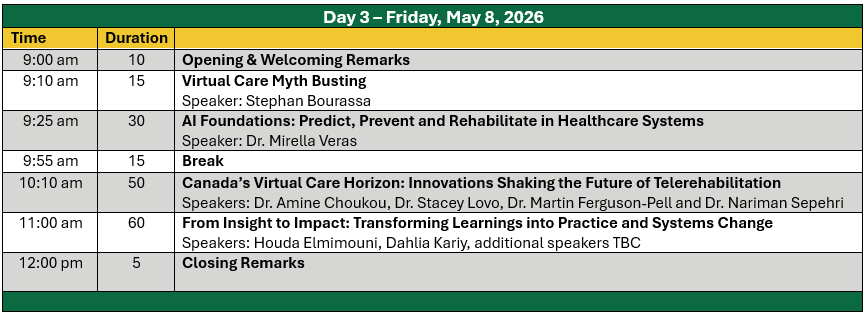
The event program and schedule can be accessed here; please note that details may be updated as needed.
Please note that the schedule is in CST (not DST).
If you would like to check your local time, conversion is available here for your convienience.
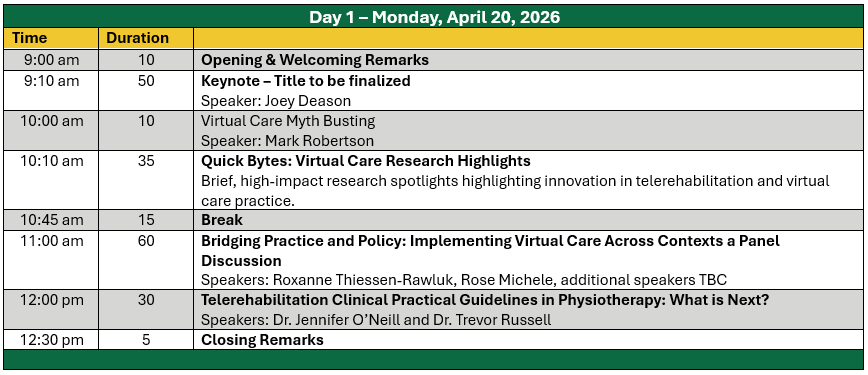
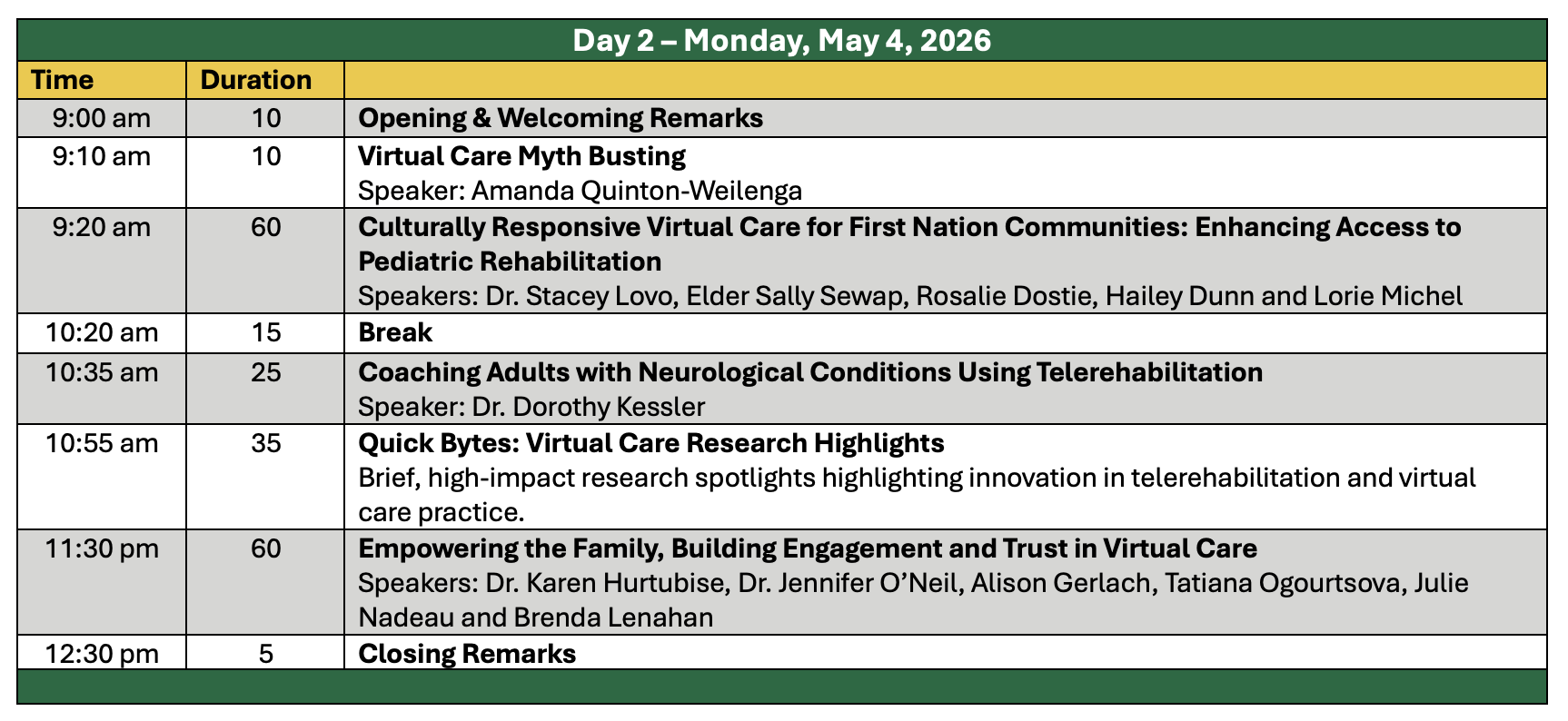
Join us on Day 1 and 2 for brief, high-impact research spotlights highlighting innovcation in telerehabilitation and virtual care practice.
Speakers
Joey Deason - Virtual Health Hub: A Healthcare Model for the Future
Joey Deason is the Director of Digital Health Projects at the Virtual Health Hub in Saskatchewan, where he leads the design, implementation, and scaling of innovative virtual care models for remote and underserved communities. His work focuses on integrating advanced technologies—such as telerobotic ultrasound, remote diagnostics, and interoperable digital platforms—into practical, system-wide solutions that improve access to care. Joey has developed structured implementation frameworks, including community readiness assessments and technology selection tools, to enable scalable and sustainable deployment of virtual health services. He collaborates closely with Indigenous partners, government agencies, and private industry to align innovation with real-world clinical and community needs. With a strong emphasis on operational execution, workforce development, and system integration, Joey plays a key role in advancing a new model of healthcare delivery that blends on-site support with remote clinical expertise, helping transform how care is delivered across geographically dispersed populations.
Mark Robertson - It's Not Just Zoom!
Mark Robertson is the Project Manager for the Children’s Therapy Network of Manitoba.
Mark has worked in a variety of roles during his career prior to joining the Children’s Therapy Network of Manitoba. Roles with Manitoba Education include provincial consultant for speech-language pathology, manager of clinician and counselling services, and manager of consultants for the blind and visually impaired. Mark served as Director of Healthy Living and Populations with Manitoba Health, Director of Alumni Relations at the University of Manitoba, and Director of Strategic Initiatives with Elections Manitoba.
Mark has worked in homes, day hospitals, hospitals, schools and personal care homes in Alberta, Manitoba, and the United States, providing speech, language, swallowing, and hearing services to clients from 11 months to 102 years of age.
Roxanne Thiessen-Rawluk - Bridging Practice and Policy: Implementing Virtual Care Across Contexts a Panel Discussion
Roxanne was born and raised in Winnipeg, Manitoba. She attended the University of Manitoba, graduating in 2003 with a Bachelor of Nursing degree. She spent the first nine years of her career at the Winnipeg's Children Hospial, first in burns and surgery, then in the Children's emergency deparmant. In 2011, she married a cattle rancher and moved into rural Manitoba, where in 2012, she was hired as a Community Health Nurse specializing in Child Health and Immunizations at Pinaymootang First Nations Health Centre.
In 2020, she took over as the nurse in charge in Pinaymootang which allowered her to expend her work within the community to include involvement in different projects that have been created to address specific gaps and barriers in both rural and Indigenous health. She looks forward to discussing the positive impacts resulting from the implementation of telerehabilitation services within the community of Pinaymootang, Manitoba.
Jennifer O'Neil - Telerehabilitaiton Clinical Practice Guidelines in Physiotherapy: What is Next?
Dr. O’Neil is a physiotherapist and assistant professor in the Faculty of Health Sciences, School of Rehabilitation Sciences at the University of Ottawa, an affiliate investigator and member of the WHO CC at the Bruyère Research Institute. Her research focuses on improving access to rehabilitation services by investigating service delivery such as telerehabilitation. Her doctorate thesis targeted the implementation of intensive home-based telerehabilitation programs for people living with moderate or severe traumatic brain injury across Canada. As an early career researcher, she is investigating the intersections between health equity, access, and telehealth services for equity-deserving groups. From a community-based approach, her work focuses on capacity building and digital health implementation, including a telehealth fall prevention program for francophone communities living in minority situations. She is passionate about improving access to rehabilitation services globally.
Stacey Lovo - Culturally Responsive Virtual Care for First Nations Communities: Enhancing Access to Pediatric Rehabilitation
Dr. Stacey Lovo is a fourth generations settler, working and living on Treaty 6 Territory and Homeland of the Métis People. She an Associate Professor in the School of Rehabilitation Science, U of Sask, and the Director of the new Virtual Health Hub, the first Indigenous led virtual. health system in Canada. Stacey works in partnership with rural and remote First Nation and Métis communities to co-develop, implement and evaluat virtual and hybrid models to enhance access to rehabilitation and primary care.
Rosalie Dostie - Culturally Responsive Virtual Care for First Nations Communities: Enhancing Access to Pediatric Rehabilitation
Rosalie Dostie is a white woman of French descent. The place she considers home is located on the traditional and unceeded lands of the W8banaki Nation. She is currently a doctoral candidate at the University of Sherbrooke and works in collaboration with several First Nations communities to improve access to culturally responsive services for children and their family.
Hailey Dunn - Culturally Responsive Virtual Care for First Nations Communities: Enhancing Access to Pediatric Rehabilitation
Hailey Dunn is a physical therapist and Ph.D candidate whose research is in collaboration with Pelican Narrows, a Cree community in Northern Saskatchewan. With the community, Hailey has explored the feasibility of a community-developed hybrid pediatric physical therapy clinic using remote presence technology. She is also working as a research associate at the Virtual Health Hub, working in several projects in collaboration with communities to enhance access to culturaaly-responsive pediatric rehabilitation care.
Dr. Dorothy Kessler - Coaching Adults with Neurological Conditions using Telerehabilitation
Dr. Dorothy Kessler is an Associate Professor in the School of Rehabilitation Therapy at Queen’s University. She trained as an occupational therapist at the University of Manitoba, received her MSc. at Dalhousie University and completed her PhD in Rehabilitation Science at the University of Ottawa. Dr. Kessler’s research focusses on understanding the experiences of people living with chronic health conditions, as well as developing and testing of interventions and models of care to improve community reintegration and participation in personally valued activities among people with chronic health conditions. She is particularly interested in interventions and technologies that integrate a compassionate approach to promote patient autonomy and competence, such as coaching and self-management.
Dr. Karen Hurtubise - Empowering the Family, Building Engagement and Trust in Virtual Care
Karen Hurtubise is a pediatric physiotherapist and rehabilitation researcher dedicated to improving access to family-centred care and family-oriented services for children with chronic conditions, disabilities, and developmental needs, and their families. Her work focuses on innovative service delivery models and models of care, including telerehabilitation and hybrid approaches, to better support families across diverse contexts. She is actively involved in multi-site Canadian research, including pragmatic randomized controlled trials and implementation studies, with a strong emphasis on co-design and interestholder engagement. Karen integrates family-centred care principles, the F-words of childhood disability framework, coaching models, adult learning theory, and relational approaches to partner with parents and young people. She is also committed to knowledge translation, developing practical tools, training programs, and policy-relevant resources. Her work aims to bridge research and practice, strengthen health system capacity, and advance equitable therapy and rehabilitation services for children and families across Canada.
more bios coming soon!
Stephan Bourassa - I Don't Have the Tools
Stephan is a pediatric occupational therapist and owner of Milestones Occupational Therapy for Children in Saskatoon, Saskatchewan, with over 25 years of clinical experience.
He specializes in child and youth mental health, with a focus on trauma, adversity, and neurodiversity-affirming, relationship-based care. Stephan has extensive experience supporting children and families from diverse backgrounds and communities including remote indigenous communities.
Committed to ongoing professional growth, Stephan has completed advanced training and certifications including the Sensory Integration Certification Program, the Neurosequential Model of Therapeutics for child trauma, and is a Certified Parent Coach. He has leaned into providing virtual care with the Virtual Health HUB to three first nations in northern Saskatchewan.
Stephan is a sought-after speaker and trainer, delivering trainings on trauma-responsive care for children and youth in the education, child protection and allied health sectors. He is often joined by Frieda, his certified therapy dog, who plays an important role in supporting client engagement.
Dr. Mirella Veras - AI Foundations: Predict, Prevent and Rehabilitation in Healthcare Systems
Dr. Mirella Veras, PhD, PT is an Assistant Professor at the University of Manitoba whose research expertise spans digital health, telerehabilitation, artificial intelligence in rehabilitation, and health equity. Her research focuses on the development and application of clinically relevant and responsible AI to support prediction, prevention, and rehabilitation across healthcare systems. This includes work in early-stage computer vision, implementation science, and ethical AI, with emphasis on fairness, transparency, accountability, and equitable access to innovation. Dr. Veras leads funded research in AI-powered rehabilitation, virtual care, and technology-enabled models of care for older adults, stroke rehabilitation, long-term care, and underserved populations. She has authored more than 40 peer-reviewed publications and has pursued advanced training in Generative AI governance, trustworthy AI, and AI integration in healthcare data.
Dr. Martin Ferguson-Pell - Canada's Virtual Care Horizon: Innovations Shaking the Future of Telerehabilitation
Martin Ferguson-Pell completed a BSc(Hons) in physics at Exeter University in the UK and then a Ph.D. in biomedical engineering at the University of Strathclyde. He has held academic appointments in Glasgow, New York (Helen Hayes Hospital and Department of Orthopedics, Columbia University) and London UK (Neuromuscular Restoration and Rehabilitation (Disability and Technology), Institute of Orthopaedics and Musculoskeletal Science, University College London) and in 2007 he was appointed Dean of the Faculty of Rehabilitation Medicine at the University of Alberta. He designed, developed and directs the UofA’s Rehabilitation Robotics Laboratory, which has a strong focus on developing point-of-care technologies that deliver comprehensive virtual clinical assessments between urban specialty clinics and rural and isolated health centres. He founded has founded two spin offs from his research. ELIXR Simulations is a non-profit taking on the challenge of ensuring that XR is used effectively in training and education where complex simulations and 3D constructs represent particular challenges for learners. Click&Push Accessibility is providing advanced approaches using novel technologies to improve accessibility to public spaces. He was the 2024 winner of the ASTech Award for Medical, Healthcare, and Pharmaceuticals - Application (Academic Collaboration).
Dr. Nariman Sepehri - Canada's Virtual Care Horizon: Innovations Shaking the Future of Telerehabilitation
Nariman Sepehri is a Distinguished Professor of Mechanical Engineering at the University of Manitoba, Canada. He is a Senior Member of IEEE, Fellow of ASME, Fellow CSME, Fellow CAE, Past-Chair ASME Fluid Power Systems and Technology Division, Co-founder and Chair of IEEE Winnipeg Robotics, Control, Instrumentation and Measurement (RobConIM) Chapter. On the rehabilitation front, he has been active in the Rehab@Home research initiative with the U of Manitoba College of Rehabilitation Sciences (lead by Dr. Tony Sztrum). The goal is to develop and validate smart devices that can be used by persons with sensory-motor impairments to rehabilitate their upper extremity. This interdisciplinary research program enables the transition of a prescribed clinical program to function in the home and community centers. His research contributions include publication of over 180 journal articles and over 155 conference papers. He holds 10 patents and is co-author of a textbook by Wiley.
Dr. Houda Elmimouni - From Insight to Impact: Transforming Learnings into Practice and System Changes
Dr. Houda Elmimouni is an Assistant Professor of Computer Science at the University of Manitoba, specializing in human-centered computing, where she studies how people interact with technologies such as communication platforms, robots, and AI systems. Her research focuses on understanding how these technologies are used in real-world and diverse social contexts, and how they can be designed to better support human values such as privacy, accessibility, identity, and trust. She uses social science methods to examine how system design shapes user experience, fairness, accountability, and trust, bringing a human-centered perspective to discussions around AI and digital systems, including in domains like virtual care. Dr. Elmimouni’s work has been published in leading international venues and has received multiple recognitions, including best paper awards at ACM CHI, UbiComp, DIS, and OpenSym. She is a recipient of NSERC and SSHRC research funding, a Fulbright Fellow, and a former Computing Innovation Fellow.
Dr. Dahlia Kairy - From Insight to Impact: Transforming Learnings into Practice and System Changes
Dahlia Kairy, PhD, is Full Professor at Université de Montréal in Québec, and a Member of the College of New Scholars, Artists and Scientists of the Royal Society of Canada since 2021. A physiotherapist by training, she has developed a research program focused on developing and implementing innovations, including telerehabilitation to improve access and provide best care. Dr. Kairy uses mixed methods approaches and works closely with clinicians, managers, patients and caregivers to support ethical and equitable evidence‑based practice change and sustainable integration of virtual care in rehabilitation.
Dr. Barbara von Tigerstorm - From Insight to Impact: Transforming Learnings into Practice and System Changes
Barbara von Tigerstrom is a Professor at the University of Saskatchewan College of Law, where she has been a member of faculty since 2005. She holds a law degree from the University of Toronto and Ph.D. in law from the University of Cambridge. Dr. von Tigerstrom’s main areas of teaching and research are health law and policy, information and privacy law, and tort law. She is the author of Information and Privacy Law in Canada and numerous articles and book chapters on privacy law, health law, and public health law and policy.
more bios coming soon!
 |
 |
 |
 |
 |
 |
 |
 |
 |
 |
 |
 |
 |
 |