Purpose
The purpose of this document is to outline Accommodation procedures for classroom, laboratory, and clinical practicum settings which are specific to the School of Rehabilitation Science (SRS). The SRS is committed to establishing and maintaining a learning environment that fosters equitable opportunities for academic success and personal development without discrimination.
This document aligns with and is a supplement to the University of Saskatchewan Duty to Accommodate Policy and Duty to Accommodate Procedures. In addition, relevant legislation under the Saskatchewan Human Rights Code was considered in the development of this document. The SRS is committed to providing reasonable accommodation(s) for students that experience barriers to their education based on a protected characteristic(s)[1].
Students who require assistance in interpreting and/or clarifying components of this document or any of the previously mentioned documents are welcome to contact the Student Affairs Coordinators in the School of Rehabilitation Science for support.
[1] As per the Saskatchewan Human Rights Code, the following grounds are prohibited against discrimination: (a) religion; (b) creed; (c) marital status; (d) family status; (e) sex; (f) sexual orientation; (g) disability; (h) age; (i) colour; (j) ancestry; (k) nationality; (l) place of origin; (m) race or perceived race; (n) receipt of public assistance; (o) gender identity.
Principles
This policy is guided by the principles of diversity, equality, and human dignity, and the values of fairness, equitable treatment, and inclusiveness.
The School of Rehabilitation Science will fulfill its obligations under the Saskatchewan Human Rights Code and adhere to relevant University of Saskatchewan policies related to reasonable accommodation for students registered with Access and Equity Services (AES) while maintaining the integrity of the SRS programs.
Scope of Policy
This policy applies to all individuals with a protected characteristic(s) at any stage of engagement with the School of Rehabilitation Science, including those considering application, currently applying, accepted, or enrolled in a program. Implementation of accommodation(s) is collaborative and is the shared responsibility of the student, staff, faculty, instructors, the Clinical Education Team, clinical preceptors, and the Access and Equity Services team.
Integrity of the SRS Programs
The following points are essential to the School of Rehabilitation Science programs and are used to determine reasonable accommodation(s) while maintaining the integrity of the program.
i. Accreditation:
All programs within the SRS are subject to accreditation by the following governing bodies:
- Master of Occupational Therapy – Canadian Association of Occupational Therapists (CAOT)
- Master of Physical Therapy - Physiotherapy Education Accreditation Canada (PEAC).
- Master of Speech and Language Pathology – Council for Accreditation of Canadian University Programs in Audiology and Speech-Language Pathology (CACUP-ASLP)
Accreditation involves ongoing assessment and improvement to meet specific standards. Being accredited shows the public and regulators that our programs are committed to high-quality education. Student accommodation(s) will be considered on a case-by-case basis but cannot compromise current accreditation requirements.
ii. Functional Competencies for Students in SRS Programs:
There are occupational requirements associated with each of the programs within the SRS. These include academic, clinical, behavioural, legal-ethical (e.g., immunization requirements, criminal record checks, insurance) and professional performance requirements. Detailed information related to these functional competencies is available in the following documents:
- Essential Skills and Attributes for Master of Occupational Therapy Students
- Essential Skills and Attributes for Master of Physical Therapy Students
- Essential Skills and Attributes for Master of Speech-Language Pathology
These documents will help students understand the expectations and demands of the programs. It is expected that all students will review the essential skills documents to identify whether they may require academic or clinical accommodation(s) due to a protected characteristic(s).
The School of Rehabilitation Science must follow agreements made with health regions and healthcare facilities to offer clinical placements for students. These agreements explain the legal and ethical rules that students must follow during their placements. Each agreement is unique and the terms can change over time. All SRS students must demonstrate competency and adherence in regard to these occupational requirements.
iii. Performance:
SRS students are expected to maintain a high level of academic performance (Academic Expectations, Academic Advancement and Promotion), exhibit professional behaviours (Professional Behaviour and Expectations Policy), as well as adhere to School of Rehabilitation Science attendance guidelines and procedures (lectures, labs and tutorials and clinical placements).
Students who require accommodation(s) related to a protected characteristic(s) under Saskatchewan human rights legislation are encouraged to register with AES to support their success in meeting these expectations.
SRS Program Duration, Leave of Absence and Admissions Deferral
Students are expected to engage in full-time study throughout the 27-month program. The program is not designed to support part-time enrolment. Individuals who are experiencing difficulties in fulfilling their obligations as a student may request a personal or health leave. These are considered on a case-by-case basis, and time spent on leave does not count toward program completion. Students returning from leave must rejoin the program at designated entry points, which may require repeating coursework or re-entering at an earlier stage of the program. Further information about Leaves of Absence, including leave categories, can be found here.
Students who have received an Offer of Admittance, and due to a protected characteristic(s), are unable to start as planned may submit a request to the admissions committee for a deferral to be considered on a case-by-case basis.
Procedures for Registration of Academic and/or Clinical Accommodation(s)
- All SRS students who are experiencing a barrier due to a protected characteristic(s) who anticipate the need for accommodation(s) for the academic and/or clinical components of the program must register with Access and Equity Services (AES) and provide them with necessary documentation.
- Information about the required documentation and process to register are on the AES website.
- Students are responsible for submitting the required documentation for the area of the relevant protected characteristic to AES to request accommodation(s).
- As part of the registration process, students will meet with an AES representative to collaboratively create their accommodation plan. They have the opportunity to ask questions and gain more information about accommodation(s), their rights, and their responsibilities.
- If a student has received approved accommodation(s) at a previous post-secondary institution or USask program, to continue with accommodations they must register with AES or renew registration to inform them of their program change and update any changes to their accommodation needs.
- Acquiring the appropriate documents and identifying accommodation needs can take time; students are encouraged to start the registration process as soon as the need for accommodation arises.
- If an unexpected need for accommodation(s) arises, the student can reach out to the Student Affairs Coordinators to support a timely registration process.
- Students are not required to disclose the nature or basis of their accommodation needs to SRS staff, faculty, instructors, or clinical preceptors.
- The student’s accommodation needs may change as they progress throughout the program. It is the students' responsibility to update AES and the SRS about any accommodation modifications.
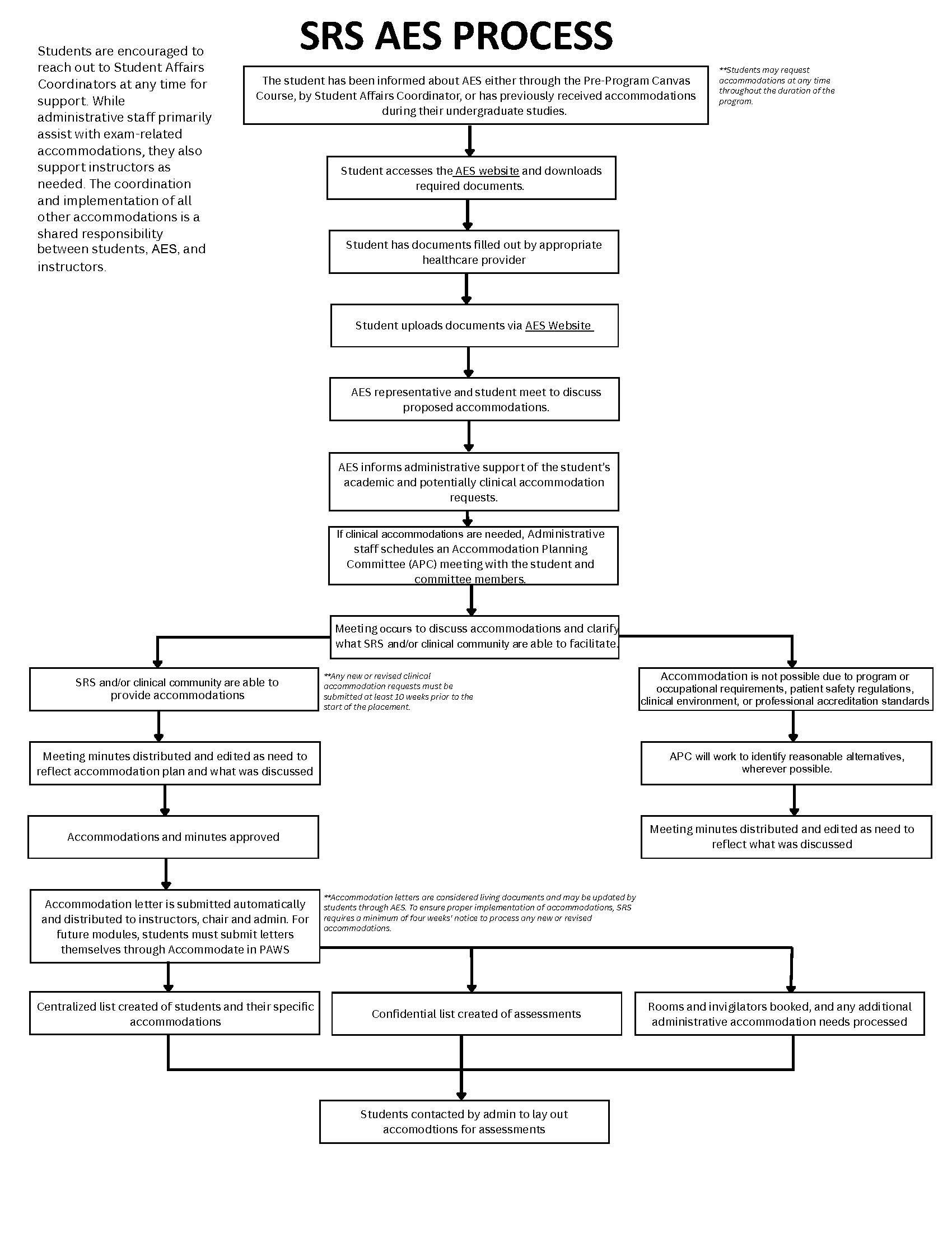
- A flowchart with the SRS AES process is available at the end of this document.
At any point in the process, support is available through AES as well as from the SRS Student Affairs Coordinators who can offer guidance about the AES registration process and connect students with additional resources.
Accommodation Planning Committee
The Accommodation Planning Committee (APC) is comprised of the student, a representative from AES, the Program Chair, a Student Affairs Coordinator, a member from the Clinical Education Team, an SRS administrative support person, and/or any other professional or staff member as needed.
The committee will convene when the need for clinical accommodation(s) is identified or when academic accommodation(s)s may cause undue hardship or risk the integrity of an SRS program.
The purpose of the APC is to support the student in their success by determining reasonable accommodation(s) and to ensure that appropriate individualized accommodation(s) is implemented proactively as the student moves through the program without compromising the essential skills and attributes that must be learned and demonstrated. Accommodation(s) may be tailored on a case-by-case basis as determined by the Accommodation Planning Committee.
It is expected that the student requesting accommodation(s) is present for all meetings, so they may ask any clarifying questions and take an active role in their accommodation plan.
The responsibility for investigating and/or sourcing these technologies is a team effort, however, the student is expected to play a major role.
Disclaimers:
- The SRS acknowledges that technologies are always being developed, adapted and improved; however, the Accommodation Planning Committee is only able to evaluate a request for accommodation given the technologies available at the time in which the request is being considered.
- An accommodation plan is designed to allow the student to meet program requirements; however, it does not guarantee successful completion of the program.
- A student has the right to waive accommodation(s) and must complete a waiver of accommodation. However, they will then be expected to meet the performance standard set without accommodation(s).
Academic Accommodation(s)
- Within the first two weeks of the start of every module, it is the student’s responsibility to submit their accommodation letter to their instructors and administrative staff through Accommodate on their Paws channel. Accommodation(s) for that module cannot be implemented without the submission of the Accommodation Letter.
- In situations where a student registers with AES during the course of an academic term, the accommodation letter should be provided to the instructor as soon as possible.
- If your accommodation(s) requires specific instructions, please communicate with your instructor and the administrative team (srs@usask.ca) to ensure they are in place correctly.
- Academic accommodation(s) related to exams (i.e. quiet, semi-private space, scheduling, etc.) are implemented internally by the SRS administrative team and instructor.
- AES coordinates certain accommodations such as note-taking services, alternate format textbooks, assistive technology, and support with disability grant funding. This can be discussed in your registration appointment. After registration you may book an appointment to discuss or update your accommodation(s) through the Accommodate channel on Paws.
- Some faculty/instructors may choose to use universal design for timed assessments. The SRS recognizes that some students may need additional time, whether through formal accommodation or to reduce the stress of timed assessments. For this reason, all students would be given the accommodation of extra time to complete their assessment. Students may self-accommodate their individual needs by using the full time if they wish, without needing to request additional time.
Clinical Accommodation(s)
- The SRS will make reasonable efforts to accommodate students with protected characteristic(s) in clinical settings. Some accommodations may not be possible due to program and occupational requirements, patient safety regulations, clinical environments, or professional accreditation standards. If an accommodation cannot be provided, the accommodation planning committee will work to identify reasonable alternatives, wherever possible.
- Duty to Accommodate Procedures: Section 9 Students enrolled in programs with professional standards or standards for licensing must meet these requirements. Consultation with professionals and/or professional licensing bodies may be undertaken when determining accommodations in a clinical practice setting.
- Clinical accommodation(s) involve coordination between AES, the SRS and health care/private settings. The goal is to confirm placements at least 8 weeks prior to the start of each placement block. Requests for accommodation(s) submitted with short notice may limit our ability to make arrangements in advance. Students are therefore encouraged to provide as much notice as possible prior to the confirmation of placements.
- If a student cannot be reasonably accommodated for a clinical placement, the placement may be deferred to a later date, which may extend the time required to complete the program.
Scholarships
Students with a protected characteristics are assessed utilizing the same criteria as other SRS students for eligibility of awards and scholarships.
Student, AES, and Joint University/ Student Responsibilities
Student accommodation(s) are a shared responsibility between the student, AES, the University community, the SRS, and the clinical community. Responsibilities of all parties involved are outlined further in the USask Duty to Accommodation Procedures and the student should familiarize themselves with that document.
The SRS will make every effort to ensure that the student’s accommodation needs are met; however, the student is expected to take an active role in their accommodation plan which may evolve as they progress through the program. This mutual responsibility will help ensure that the students’ accommodation needs are addressed during the diverse educational activities both on and off campus, and throughout the varied student evaluations.
Documentation
The supporting documentation that provides evidence for the required accommodation(s) will be housed in the AES office and subject to USask privacy and confidentiality policies.
The accommodation plan that has been implemented will be kept in the student’s SRS Accommodation file which is separate from their academic file.
The Accommodation Planning Committee will keep a record of all information regarding the request for accommodation.
This includes:
- the nature of the accommodation provided
- the dates of implementation
- any subsequent modification to the original accommodation
- meeting minutes
- any self-disclosed information the student would like the accommodation planning committee to know.
Privacy
Confidentiality of all students’ personal information will be maintained at all times.
Particulars of a student’s reason for registering with AES will not be disclosed to anyone without the express consent of the student.
Particulars regarding a student’s accommodation plan may be shared on a need to know basis.
Dispute Resolution
If there are any questions or concerns about an accommodation decision made through the AES process, these should be addressed first to AES or SRS staff for informal resolution.
If informal resolution cannot be reached, the Vice-Provost, Teaching and Learning (VPTL) may be asked to review the accommodation decision, provided that the review request is made in a timely manner. The VPTL will seek appropriate legal advice from the Legal Office prior to rendering their decision. The decision of the VPTL on the review is final.
Policy Review
The School of Rehabilitation Science Academic and Clinical Accommodation Procedure will be reviewed by the Academic Affairs committee, in consultation with AES, and modified as needed.
SRS AES Process